
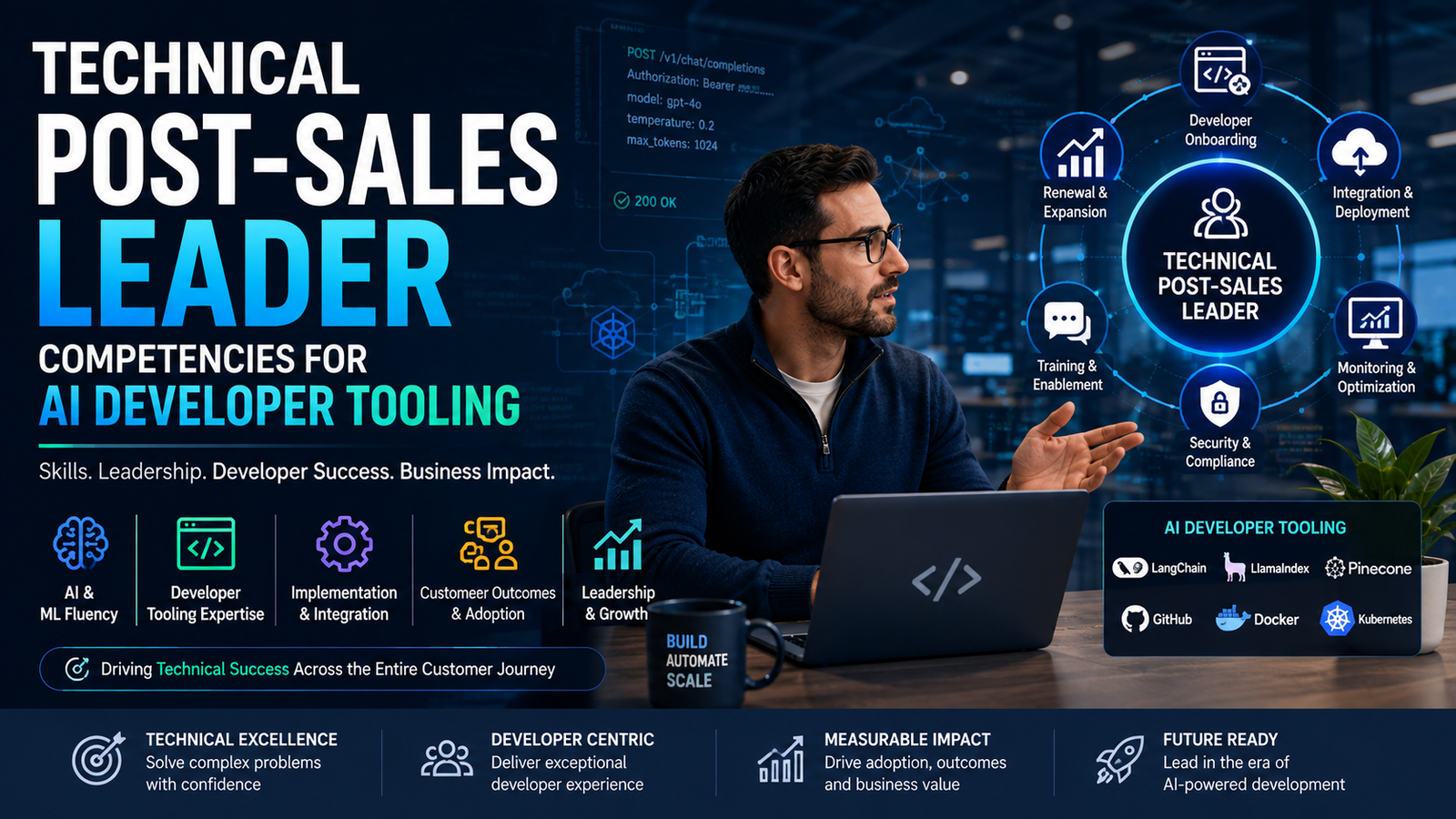
AI developer tools are changing what happens after a contract is signed. A customer may need more than configuration and training: the vendor may have to help with APIs, cloud architecture, CI/CD, data pipelines, evaluation, observability, security, developer adoption and production troubleshooting. Current role descriptions reflect this shift. For example, CodeRabbit’s post-sales field-engineering manager role combines onboarding, implementation, customer enablement, technical escalations, architecture reviews, team leadership and long-term adoption for an AI-powered developer platform. See the current CodeRabbit role description Google Cloud’s current GenAI Forward Deployed Engineer role similarly asks for production AI delivery, RAG/vector-database pipelines, customer technical discovery, cloud architecture and LLM-native metrics such as tokens per second and cost per request. See Google Cloud’s role requirements
What Is a Technical Post-Sales Leader?
A technical post-sales leader is responsible for turning a sold technical solution into a successful, adopted and supportable production outcome. The exact title varies by company—Field Engineering Manager, Customer Engineering Leader, Technical Account Management leader, Post-Sales Engineering leader or a related title—but the recurring responsibilities are similar.
- Lead onboarding and implementation programs.
- Guide integrations, architecture and production deployment.
- Coach customer-facing technical teams.
- Own or coordinate complex technical escalations.
- Create repeatable implementation and onboarding playbooks.
- Measure adoption, technical health and time-to-value.
- Translate customer feedback into product and engineering priorities.
- Build trust with developers, platform teams, security teams and executives.
- Connect technical delivery with renewals, expansion and measurable business outcomes.
Why AI Developer Tooling Changes the Role
Traditional SaaS post-sales work often revolves around configuration, workflow setup and user training. AI developer tooling adds a deeper engineering layer. A customer may be integrating an AI code reviewer, coding assistant, model gateway, agent framework or AI-enabled developer platform into a real software-development environment.
That means the post-sales team may have to reason about model behavior, retrieval quality, context, tool calls, latency, token usage, security, observability, CI/CD, cloud architecture and evaluation. A 2026 meta-analysis of 23 studies found a moderate positive average effect of generative-AI coding assistance on developer productivity, but also substantial variation by context; this is one reason a post-sales leader should measure outcomes rather than assume that AI adoption automatically equals productivity.
Google’s current GenAI FDE role is a useful market signal: it explicitly combines customer discovery, production AI architecture, RAG/vector pipelines, multi-agent systems and LLM-native operational metrics with post-sales or technical-consulting experience.
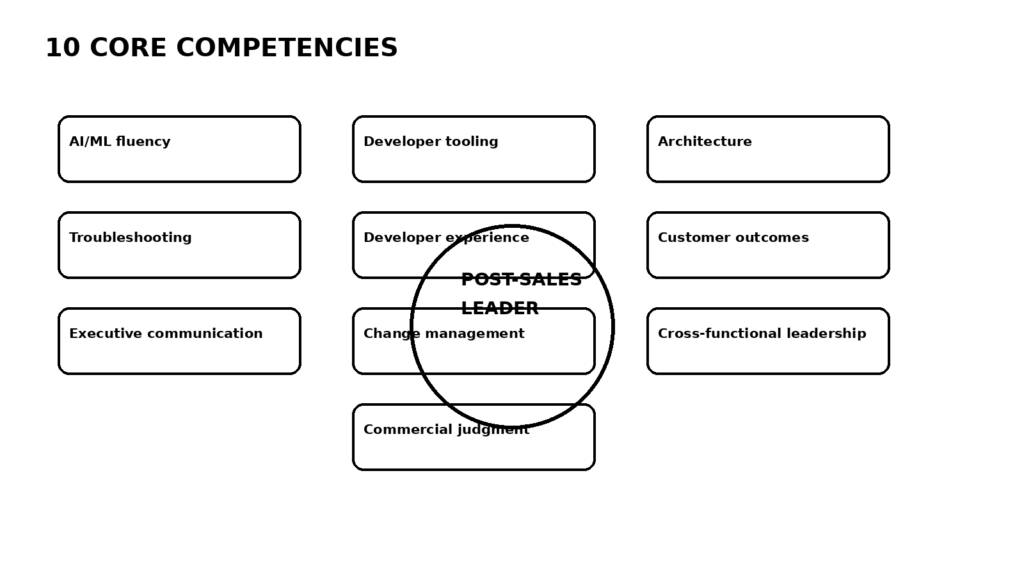
ALT: Ten competency areas for technical post-sales leadership in AI developer tooling.
10 Core Technical Post-Sales Leader Competencies
1. AI and ML Fluency
The leader does not need to be a research scientist, but should understand LLMs, embeddings, RAG, inference, evaluation, context windows, tool calling, agents, fine-tuning and common failure modes. The goal is technical judgment: knowing what a product can reliably do, where it needs evaluation and where a human should remain in the loop.
2. Developer Tooling Expertise
Strong working knowledge of APIs, SDKs, Git, GitHub/GitLab, CLI workflows, authentication, webhooks, containers, CI/CD and cloud environments makes it easier to diagnose customer friction. The current CodeRabbit post-sales manager role explicitly calls out software-development tools, APIs, cloud infrastructure and CI/CD.
3. Integration and Architecture
The leader should be able to map the product into the customer’s architecture: identity, network boundaries, data flows, APIs, repositories, CI/CD, model providers, logging and monitoring. Architecture reviews should result in concrete implementation decisions, not only diagrams.
4. Technical Troubleshooting
AI incidents require structured diagnosis. If an assistant produces poor answers, the root cause could be the model, prompt/context, retrieval layer, source data, tool call, permissions, deployment environment or an upstream service. A good post-sales leader builds repeatable escalation paths and teaches teams to isolate causes before escalating.
5. Developer Experience
For developer tools, the user is often the engineer. Documentation, SDK quality, CLI behavior, error messages, onboarding, debugging and time-to-first-success can determine whether adoption spreads. A useful leader treats developer experience as an operational metric, not a cosmetic concern.
6. Customer-Outcome Ownership
Customer health should be connected to outcomes: time-to-value, production deployment, active usage, adoption across teams, incident reduction, productivity evidence, cost control and business impact. ‘The customer likes the product’ is not a sufficient technical success metric.
7. Executive Communication
The same technical situation must be explained at multiple levels. Engineers may need logs, architecture and failure modes; executives may need risk, impact, cost, timeline and business value. The leader translates without losing technical accuracy.
8. Change Management
AI changes workflows, not only software. Teams may need training, champions, governance, approval policies, evaluation routines and new developer habits. Post-sales leaders should plan for adoption resistance and organizational change.
9. Cross-Functional Leadership
The role sits between Sales, Customer Success, Product, Engineering, Support, Security and the customer. The leader needs clear ownership rules for handoffs, escalations and feedback loops so customer problems do not disappear between teams.
10. Commercial Judgment
A technical leader should know when expansion is justified and when the customer first needs stabilization. The best commercial outcome often follows technical credibility: successful production use creates the evidence for renewal and expansion.
Technical Post-Sales vs Similar Roles
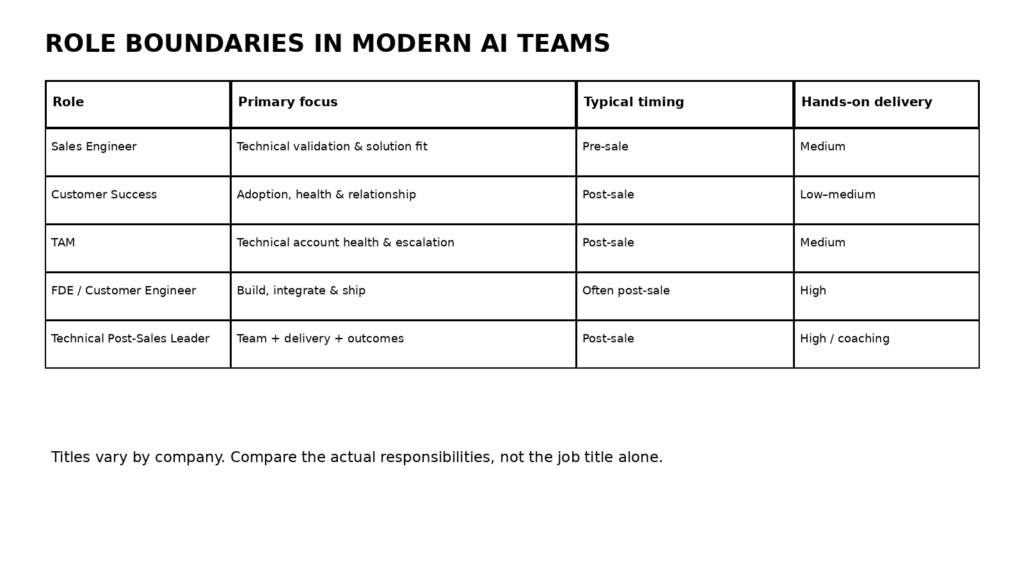
ALT: Comparison of sales engineering, customer success, TAM, FDE and technical post-sales leadership.
| Role | Primary focus | Typical timing | Hands-on delivery |
| Sales Engineer | Technical validation and solution fit | Pre-sale | Medium |
| Customer Success | Adoption, health and relationship | Post-sale | Low–medium |
| Technical Account Manager | Technical account health and escalation | Post-sale | Medium |
| Forward Deployed / Customer Engineer | Build, integrate and ship customer solutions | Often post-sale | High |
| Technical Post-Sales Leader | Team, delivery, adoption and outcomes | Post-sale | High / coaching |
Titles are not standardized. The responsibilities in the job description matter more than the label. A recent Reddit discussion from practitioners also shows the overlap: some companies treat FDE as post-sales delivery, while others place it closer to pre-sales or technical consulting. Use community discussions as qualitative evidence, not as a universal definition.
The Post-Sales AI Developer Tooling Lifecycle
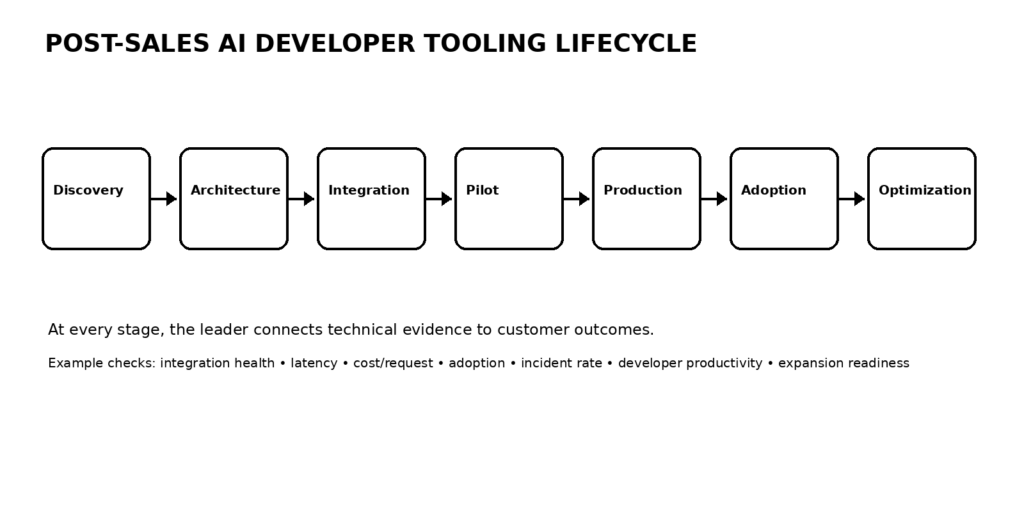
ALT: Customer lifecycle from discovery to architecture, integration, pilot, production, adoption and optimization.
A repeatable lifecycle prevents post-sales teams from becoming reactive support desks. The leader should define exit criteria for each stage.
- Discovery: define the customer’s workflow, technical constraints, stakeholders and success criteria.
- Architecture: agree on data flows, integrations, security boundaries and operating model.
- Integration: connect APIs, repositories, identity, cloud resources and developer workflows.
- Pilot: test a narrow use case with explicit evaluation criteria.
- Production: monitor reliability, latency, cost, security and user behavior.
- Adoption: train teams, identify champions and remove workflow friction.
- Optimization: improve quality, cost, performance and expansion readiness.
Technical Post-Sales KPIs
| KPI | What it measures | Why it matters |
| Time to Value | How quickly the customer reaches a defined outcome | Early indicator of implementation quality |
| Time to Production | Time from kickoff to production use | Shows delivery efficiency |
| Adoption Rate | Actual usage across the target team | Separates installation from real adoption |
| Technical Escalation Rate | Issues requiring higher-level intervention | Reveals product or enablement friction |
| Resolution Time | Time to restore or resolve technical issues | Measures operational effectiveness |
| Deployment Success Rate | Share of implementations reaching agreed production criteria | Shows repeatability |
| Renewal / Expansion | Commercial outcomes influenced by technical success | Connects delivery to business value |
| Developer Activation | How quickly developers reach useful activity | Useful for developer-facing products |
AI-Specific Metrics Leaders Should Add
AI developer tooling requires additional measures because usage alone can hide quality or cost problems. Research on AI developer productivity argues for a multidimensional view rather than relying on a single metric. A 2026 study involving 2,989 developer survey responses and interviews identified multiple short- and long-term factors that should be considered when evaluating AI-assisted productivity.
- Evaluation score / task success
- Hallucination or incorrect-output rate
- Latency
- Tokens per second
- Cost per request / workflow
- Tool-call success rate
- Retrieval quality
- Agent task-completion rate
- Human intervention rate
- Production incident rate
Google’s current GenAI FDE requirements explicitly mention LLM-native metrics such as tokens per second and cost per request, reinforcing the need to treat AI operations as measurable engineering work rather than a vague ‘AI adoption’ project.
Tools a Technical Post-Sales Leader Should Understand
| Category | Examples | Why the leader needs it |
| Developer platforms | GitHub, GitLab, Git, CI/CD platforms | Repositories, pull requests, automation and release workflows |
| Cloud | AWS, Azure, Google Cloud | Identity, networking, compute, storage and production architecture |
| Containers | Docker, Kubernetes | Deployment and operational environments |
| AI application layer | Model APIs, RAG/vector databases, agent frameworks | Production AI integration |
| Observability | Logs, traces, metrics, AI-specific evaluation and cost tracking | Reliability and troubleshooting |
| Collaboration | Slack, Jira, Notion or equivalents | Customer/project coordination |
Example: When an AI Developer Tool Works in a Pilot but Fails in Production
Imagine a customer says an AI coding assistant performed well during a pilot but now produces inconsistent results across a larger repository.
1. Check the model and version: did the model, provider or routing change?
2. Check context: is the production workflow supplying the same information as the pilot?
3. Check retrieval: are the correct files or knowledge sources being retrieved?
4. Check permissions and integrations: can the tool access the same repositories, APIs and services?
5. Check evaluation: are failures measured against a fixed test set rather than anecdotes?
6. Check cost and latency: is scale causing throttling, slower responses or unexpected spend?
7. Check human workflow: are developers using the tool differently after rollout?
8. Escalate with evidence: provide logs, reproduction steps, architecture context and evaluation results.
This is the difference between reactive support and technical post-sales leadership: the leader creates a repeatable diagnostic system that converts customer pain into evidence and action.
Research Evidence: What the Market Is Signaling
Current job descriptions show that AI-native post-sales work is converging with customer engineering and forward-deployed engineering. CodeRabbit’s manager role explicitly combines post-sales leadership with developer tooling, APIs, cloud, CI/CD, technical escalations and customer adoption. Google Cloud’s GenAI FDE role adds RAG/vector pipelines, multi-agent systems, production AI delivery and LLM-native metrics. OpenRouter’s current FDE posting describes the role as post-sales work spanning customer success, support, customer engineering, product and developer relations, with responsibility for production integration and inference architecture.
OpenRouter role: Forward Deployed Engineer
Community evidence points in the same direction, while also warning that titles are inconsistent. Practitioners describe FDE as a mix of engineering, consulting and post-sales delivery; others see it closer to pre-sales. The safe conclusion is not that every company uses the same model, but that customer-facing AI engineering increasingly requires both technical execution and stakeholder skills.
How to Research This Topic Properly
- Start with current first-party job descriptions from AI developer-tool companies and cloud providers.
- Extract recurring responsibilities and skills instead of copying one job description.
- Compare at least five roles across post-sales, field engineering, FDE, TAM and solutions engineering.
- Use academic research to validate claims about AI productivity, developer experience and AI-system evaluation.
- Use Reddit for practitioner language, role ambiguity and real-world pain points.
- Use YouTube interviews, conference talks and demos to discover terminology and workflows; verify factual product claims against first-party documentation.
- Record publication dates because AI tooling changes quickly.
- Separate evidence into first-party, academic, industry and community sources.
- Add original synthesis: competency matrices, KPI frameworks, troubleshooting workflows and role comparisons.
YouTube Research Plan
Recommended research queries:
- technical post sales engineer AI
- post sales engineering developer tools
- AI solutions engineering
- forward deployed engineer AI
- developer tooling customer success
- developer experience AI tools
- technical account manager AI
- AI developer tools enterprise deployment
Use videos for interviews, demos and practitioner context. Do not treat a creator’s statement about pricing, security, capabilities or product roadmaps as authoritative unless it can be verified in official documentation.
SEO: What Google Actually Wants
There is no Google ‘SEO pass score’ that guarantees rankings. Google’s current Search Central guidance says its systems prioritize helpful, reliable, people-first content and encourages creators to provide original information, substantial coverage, insightful analysis, clear authorship and trustworthy sourcing. It also explicitly says there is no preferred word count.
Google guidance: Creating Helpful, Reliable, People-First Content
For this article, the strongest SEO strategy is therefore not keyword density. It is topical completeness plus original research and useful evidence.
Title/H1: Use the primary topic naturally and make the promise clear.
Semantic coverage: Cover post-sales engineering, developer tooling, AI/ML, FDE, TAM, customer engineering, DX, KPIs and implementation.
Internal linking: Link to relevant AI, DevOps, developer-tooling and customer-success resources on your own site.
External references: Use authoritative first-party, academic and reputable industry sources.
Authorship: Show a real author and, where appropriate, a technical reviewer.
Freshness: Update substantive facts when roles, tools or research change; do not change dates without meaningful updates.
Images: Use original diagrams with descriptive filenames and ALT text.
Structured data: Consider Article/BlogPosting markup with accurate author, headline, image and publication metadata.
E-E-A-T and the Who / How / Why
Google’s current guidance encourages clear authorship and transparency about how content was produced. For a research-led technology article, add a byline, author page, publication/update dates and a short methodology note. If AI assistance was used, disclose it where readers would reasonably want to know how the content was created. Do not invent first-hand testing or claim to have interviewed people unless that actually happened.
Google guidance: Who, How and Why
Recommended Article Internal-Link Cluster
- AI developer tools
- AI agents
- Developer experience
- RPA and workflow automation
- DevOps and CI/CD
- Technical account management
- Customer success
- AI productivity
- Enterprise AI implementation
- AI governance and security
These should point to real, relevant pages on the publishing site. Do not create thin pages solely to manufacture internal links.
Common Mistakes to Avoid
- Treating ‘technical post-sales leader’ as a standardized title when companies use different names.
- Copying a job description and presenting it as original research.
- Claiming AI productivity gains without discussing context and measurement.
- Using Reddit as if it were authoritative documentation.
- Using YouTube opinions as product specifications.
- Filling the article with generic AI buzzwords instead of concrete workflows.
- Publishing many near-duplicate pages for keyword variations.
- Inventing first-hand product tests, interviews or customer results.
- Adding external links only for SEO rather than because they support a claim.
FAQ
What does a technical post-sales leader do?
They lead the technical work required after a sale: onboarding, implementation, integration, architecture, escalations, enablement, adoption and long-term technical success.
What competencies does a technical post-sales leader need?
AI/ML fluency, developer-tooling knowledge, architecture, troubleshooting, developer experience, customer-outcome management, executive communication, change management, cross-functional leadership and commercial judgment.
How is post-sales different from solutions engineering?
Solutions engineering is commonly pre-sales and focused on technical validation and solution fit. Post-sales focuses on successful deployment, adoption and ongoing customer outcomes. Companies may blend these responsibilities.
What is an FDE in AI?
A Forward Deployed Engineer is typically a highly hands-on customer-facing engineer who helps build, integrate and deploy solutions in a customer’s environment. The exact scope varies by company.
Which AI skills matter most after the sale?
Understanding LLM behavior, RAG, evaluation, tool calling, agents, APIs, cloud architecture, observability, security and cost/performance tradeoffs.
What KPIs should post-sales leaders track?
Time-to-value, time-to-production, adoption, deployment success, escalation rate, resolution time, developer activation, renewal/expansion and AI-specific quality/cost metrics.
How do you evaluate AI developer-tool productivity?
Use multiple measures: task success, quality, developer time, adoption, review effort, reliability, latency and cost. A single activity metric rarely captures the full impact.
Is AI replacing post-sales engineering?
The evidence points more toward role transformation than simple replacement. AI can reduce repetitive work while increasing the importance of technical judgment, verification, integration and customer-facing problem solving.