
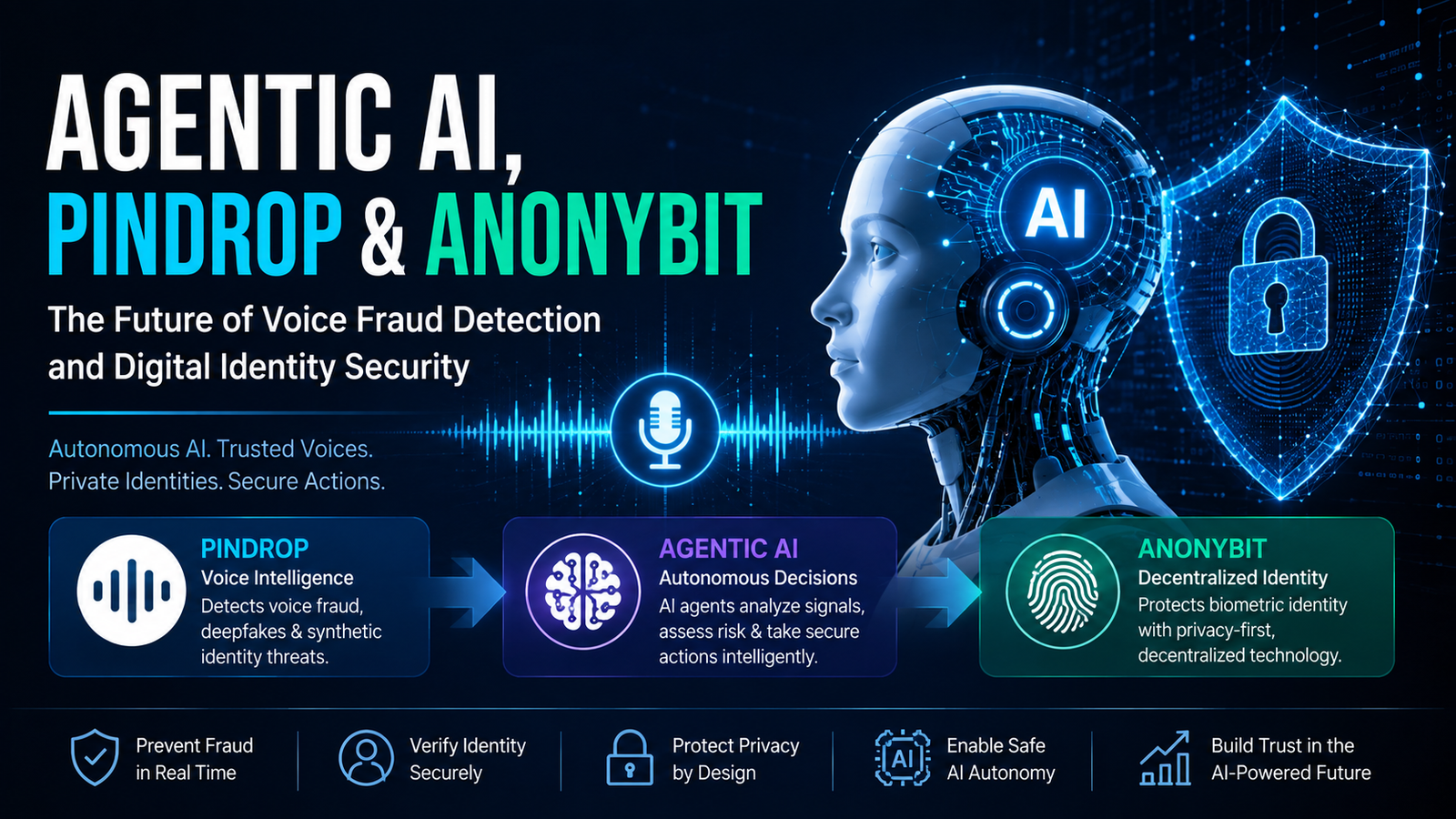
Agentic AI is moving artificial intelligence from systems that mainly generate answers toward systems that can plan, use tools, make decisions and execute tasks on a user’s behalf. That shift creates a new security question: when software can act autonomously, how does an organization know who authorized the action, whether the surrounding identity signals are trustworthy, and whether the requested action should be allowed?
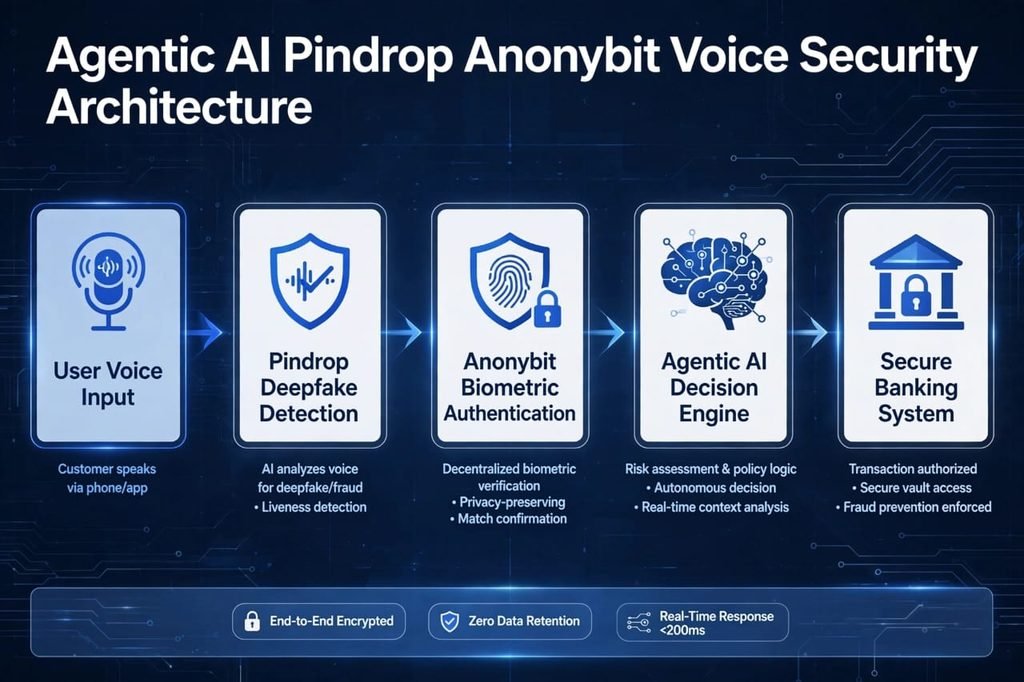
Table of Contents
The problem becomes more urgent when synthetic media is added to the picture. A convincing cloned voice can be used to impersonate a customer, executive or employee. Pindrop focuses on detecting and analyzing voice and other interaction signals for fraud and deepfake defense, while Anonybit focuses on privacy-preserving decentralized biometric identity. These capabilities address different parts of the trust problem. Agentic AI, meanwhile, supplies an action and orchestration layer.
The most useful way to understand the phrase “agentic AI Pindrop Anonybit” is therefore not as the name of a single technology, but as a security architecture question: how can autonomous systems combine strong identity, interaction-level risk signals and tightly controlled authorization?
What is Agentic AI Pindrop Anonybit?
Agentic AI describes AI systems designed to pursue goals through multiple steps rather than only responding to a single prompt. Depending on the implementation, an agent may interpret a request, plan a sequence, call tools or APIs, inspect results, revise its plan and take further actions.
NIST’s 2026 work on AI agent security highlights a core issue: agents can access diverse datasets, tools and applications, which makes identification and authorization controls especially important. NIST’s AI Agent Standards Initiative also identifies agent authentication and identity infrastructure as active research areas.
What Is Pindrop in Agentic AI Pindrop Anonybit Security?
Pindrop is a voice and interaction security company whose technology is designed to help organizations detect fraud and synthetic media in real-time communications. Its security materials describe capabilities for deepfake detection, voice authentication, liveness and risk analysis across customer interactions.
One important capability is analyzing speech characteristics to distinguish human callers from synthetic audio. Pindrop also describes continuous risk scoring throughout a call, rather than treating authentication as a single yes/no event.
Pindrop publishes research on the growth of synthetic voice and deepfake fraud. These statistics are company-reported and should be attributed as such when used.
What Is Anonybit and Its Role in Agentic AI Pindrop Anonybit?
Anonybit focuses on privacy-preserving biometric identity. Its approach distributes biometric information rather than maintaining a conventional central repository containing complete biometric records. Anonybit describes decentralized storage and processing, including multi-party computation and zero-knowledge techniques, to support biometric matching while reducing exposure of sensitive identity data.
The company says its platform supports biometric authentication and matching across the identity lifecycle, including passwordless access, step-up authentication, wire verification and account recovery. In 2024, Anonybit announced support for iris and voice recognition alongside existing face and palm modalities.
How Do Agentic AI Pindrop Anonybit Work Together?
The three should be understood as complementary layers rather than interchangeable products. Agentic AI provides autonomy and orchestration. Pindrop can provide voice and interaction risk signals. Anonybit can provide a privacy-preserving biometric identity layer.
A useful architecture therefore separates four questions: Is the interaction suspicious? Who is the person? What is the agent authorized to do? And what should happen when risk is elevated?
Agentic AI Pindrop Anonybit: A Practical Security Architecture
Consider a financial-services contact center where an autonomous fraud assistant is allowed to recommend actions, but a high-value transaction requires strong identity assurance. A caller’s voice can be analyzed for synthetic-media indicators, while the agent evaluates the request against policy and transaction context. If risk crosses a threshold, the workflow can require an additional identity step before any sensitive action is approved.
The key principle is separation of duties. Detection should not automatically equal authorization. A deepfake detector can raise a risk signal, but the system still needs a policy that explains what happens next. Likewise, successful biometric verification should not automatically grant an AI agent unlimited permissions.
Why Voice Deepfakes Matter for Agentic AI Pindrop Anonybit Security?
Human perception is not a reliable standalone defense against synthetic speech. Pindrop cites research showing that people can fail to identify a portion of deepfake speech samples, reinforcing the value of automated liveness and fraud controls.
Pindrop has also published data from its analysis of more than a billion calls and reported a substantial year-over-year increase in deepfake activity in its 2025 report. Because this is vendor research, the figures should be attributed to Pindrop rather than presented as universal industry measurements.
Why Identity Becomes Harder With AI Agents
Traditional applications usually have a relatively clear principal: a user signs in, receives permissions and performs an action. Agentic systems complicate that model because an agent may act for a person, call another service, delegate a task or operate across multiple systems.
NIST’s 2026 concept paper specifically calls out identification, authorization, auditing and non-repudiation for AI agents. Recent academic work is exploring AI-agent identity, delegation of authority and the possibility of binding human biometric assurance to an agent’s identity and scope. These are research directions, not evidence that any one commercial product has implemented the proposed frameworks.
Where Pindrop Can Fit in Agentic AI Pindrop Anonybit Architecture
Pindrop can fit into an agentic security architecture as a source of interaction-level evidence: synthetic-media indicators, liveness signals, fraud risk and call intelligence. Its 2026 Fraud Assist announcement is especially relevant because Pindrop describes Fraud Assist as an AI agent for phone-fraud investigations that can summarize calls, translate content and generate case notes. This is a concrete example of an AI agent being used inside a fraud workflow; it should not be confused with a claim that Pindrop and Anonybit are one integrated platform.
Where Anonybit Can Fit in Agentic AI Pindrop Anonybit Security
Anonybit can fit as an identity-assurance layer when a workflow needs stronger proof of the person behind an interaction. Its published architecture describes distributed storage and processing of biometric data, with support for multiple modalities. This can be conceptually useful in an agentic workflow where a high-impact action requires stronger proof that the authorized person is actually present.
Use Cases
Banking and payments: a synthetic-voice risk signal could trigger step-up identity verification before a transfer, account change or recovery action is permitted.
Contact centers: continuous interaction assessment can help escalate suspicious requests instead of trusting the voice alone.
Executive impersonation: high-risk payments or credential requests should require independent verification and transaction-level authorization.
Account recovery: privacy-preserving biometric verification can be one layer in a recovery process while the agent remains limited to a tightly defined scope.
AI-agent delegation: when a person delegates a task to an AI agent, the organization needs to know what the agent is allowed to do and under which identity.
Agentic AI, Pindrop and Anonybit: Role Comparison
| Technology | Primary role | Security question | Example output |
|---|---|---|---|
| Agentic AI | Planning, reasoning and action | Is the requested action authorized? | Route, approve, escalate or execute |
| Pindrop | Voice/interactions and fraud signals | Is this interaction synthetic or suspicious? | Risk / liveness / fraud assessment |
| Anonybit | Privacy-preserving biometric identity | Can the legitimate identity be verified? | Biometric match / step-up verification |
Figure 2. The three technologies have different primary roles.
Example: AI Voice Impersonation Against an Autonomous Workflow
Figure 3. Example threat flow.
- An attacker creates synthetic audio that imitates a trusted person.
- The call enters a customer or employee workflow.
- Voice and interaction signals are assessed for synthetic or anomalous behavior.
- The agentic system checks the requested action against policy and authorization scope.
- A higher-risk event triggers biometric, MFA or human verification.
- The final action is allowed, restricted, escalated or blocked according to policy.
Limitations and Risks
- No detector is perfect; synthetic-media techniques evolve.
- Biometrics are sensitive and require strong privacy, retention, consent and governance controls.
- Agent permissions can create blast radius; agents should receive only task-required access.
- A risk score is not a policy; organizations must define operational responses.
- Human review remains important for high-impact decisions.
- Vendor statistics should be attributed and contextualized.
- Integration across voice, identity, fraud, IAM and agent orchestration can be complex.
What Google-Friendly, Evidence-Based Content Looks Like
- Use the primary phrase naturally in title, introduction and a relevant section.
- Cover related entities: agentic AI security, voice fraud, deepfake detection, biometric identity and AI-agent authorization.
- Use primary sources for product capabilities and statistics.
- Use NIST and academic research for broader security concepts.
- Add original diagrams and comparison tables.
- Clearly label vendor-reported statistics and research hypotheses.
- Use an accurate author bio and genuine expertise.
- Add internal links to related articles on the publishing site.
- Use descriptive image filenames and alt text.
- Separate verified facts, vendor claims and editorial analysis.
Keyword Intent Map
| Keyword cluster | Intent | Section |
| agentic ai pindrop anonybit | Core informational | Introduction + relationship |
| Pindrop voice security | Informational/commercial | Pindrop |
| Pindrop deepfake detection | Informational | Deepfake section |
| Anonybit decentralized biometrics | Informational/commercial | Anonybit |
| agentic AI security | Informational | Agentic AI + identity |
| AI identity verification | Informational | Identity architecture |
| AI voice fraud detection | Informational/commercial | Threat model |
| deepfake voice detection | Informational | Voice section |
| AI agent authentication | Informational | Agent identity |
| biometric identity security | Informational | Anonybit + risks |
Frequently Asked Questions
What is agentic AI?
Agentic AI refers to AI systems that can pursue goals through multi-step reasoning, tool use and autonomous actions, subject to operator controls.
What does Pindrop do?
Pindrop provides technology for voice and interaction security, including fraud detection, authentication and synthetic-media/deepfake detection.
What is Anonybit?
Anonybit is a privacy-focused biometric identity platform using decentralized approaches to store and process sensitive identity data.
Are Pindrop and Anonybit the same technology?
No. Pindrop emphasizes voice and interaction security, while Anonybit emphasizes privacy-preserving biometric identity.
How can agentic AI use voice-security signals?
An agent can consume a voice or interaction risk signal as one input to a policy decision, while high-risk actions can be routed to step-up verification or human review.
Can AI agents prevent deepfake fraud by themselves?
No. Detection, identity assurance, authorization, transaction controls and human oversight should work together.
Why does AI-agent identity matter?
Because an autonomous agent may access tools, data and transactions. Organizations need to know which principal authorized the agent, what it may do and how permissions are audited.