
AI automation is changing how people handle everyday work. Tasks such as sorting leads, moving information between apps, writing first-draft replies, updating a CRM, summarizing documents, and routing support requests can now be handled with much less manual effort.
That is why people searching for “droven io ai automation tools” often want a simple answer: What is Droven.io, is it an automation product, and which AI automation tools are actually useful?
The important point is that Droven.io currently presents itself as an editorial and information website focused on artificial intelligence, technology, digital transformation, AI tools, AI automation work, and business processes. In other words, it is better understood as a place to learn about these topics than as a standalone workflow builder.
| Quick answer: Droven.io is an AI and technology editorial platform. The phrase “Droven IO AI automation tools” is best understood as a search for the automation tools, ideas, and business use cases connected with the subjects Droven.io covers. |
What Is Droven.io?
Droven.io describes itself as a source for AI, technology, and digital transformation insights. Its website includes sections such as AI Tools & Applications, AI Automation Work, AI in Business & Marketing, AI Business Processes, Digital Transformation, and technology reviews.
The Droven.io homepage says it is a “trusted editorial source” for people navigating AI and the digital future. That wording matters because it helps separate the site itself from the software products it may discuss.
So, if you land on Droven.io while researching automation, think of it as a knowledge hub. You may find articles about AI workflows, business efficiency, tools, agents, software, and digital change, but that does not mean Droven.io is the software running those workflows.
Is Droven.io an AI Automation Tool?
Based on its current public website, no. Droven.io is not presented as a Zapier-style workflow builder, an n8n-style automation platform, or an RPA suite like UiPath. It does not publicly position itself as a product where users sign in, connect apps, build triggers and actions, and run automations.
This is an important SEO and accuracy point. Articles targeting the keyword should avoid inventing Droven.io features, pricing, dashboards, integrations, or automation capabilities that are not shown on its official site.
What Does “Droven IO AI Automation Tools” Mean?
The keyword has mixed intent. A reader may be looking for information about Droven.io, but they may also be trying to discover tools that can automate business work with AI. A useful article should answer both needs instead of treating the phrase as the name of one specific software product.
- What Droven.io is and what type of content it publishes.
- What AI automation means in simple language.
- Which types of AI automation tools exist.
- How tools such as Zapier, Make, n8n, Microsoft Power Automate, and UiPath differ.
- Which business tasks are good candidates for automation.
- How to choose a tool based on skill level, integrations, privacy, control, and scale.
What Is AI Automation?
AI automation means using artificial intelligence inside a workflow so the system can do more than follow fixed rules. Traditional automation is usually based on a simple “if this happens, do that” pattern. AI can add abilities such as understanding text, classifying information, summarizing content, extracting details, generating a draft, or choosing between different next steps.
IBM defines AI workflow automation as the use of AI-powered technologies to automate tasks and streamline activities in an organization. The AI may work on its own for some steps or work together with people.
A simple example is a support workflow. A normal automation can send every new support email to the same inbox. An AI-assisted workflow can read the message, decide whether it is about billing, a technical issue, or a refund request, and then route it to the right team. A human can still review sensitive or important cases.
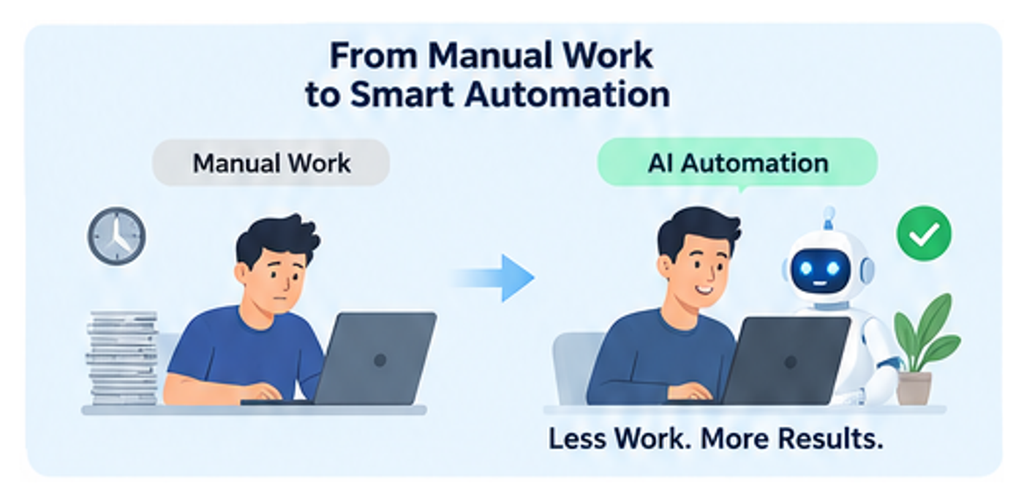
AI automation can reduce repetitive manual work while keeping people involved where judgment is needed.
The Main Types of AI Automation
AI automation is not one single technology. The easiest way to understand it is to separate it into a few practical categories.
1. Workflow Automation
Workflow automation connects apps and moves information between them. For example, when a lead fills out a form, the workflow can add that lead to a CRM, notify a sales rep, create a follow-up task, and start an email sequence.
2. Robotic Process Automation (RPA)
RPA is useful when a task happens inside software that may not have a clean API or modern integration. A software robot can imitate repetitive computer actions such as copying values, opening screens, entering data, or moving information between systems.
3. AI Agents
AI agents can work toward a goal, use tools, read context, and make limited decisions. For example, an agent might review new leads, research basic company details, score them against rules, and prepare a short summary for a salesperson. Good systems still use permissions, logs, and human approval for higher-risk actions.
4. AI Orchestration
Orchestration is about coordinating multiple apps, models, agents, data sources, and rules in one larger process. It becomes more important as a company moves from a few small automations to many connected workflows.
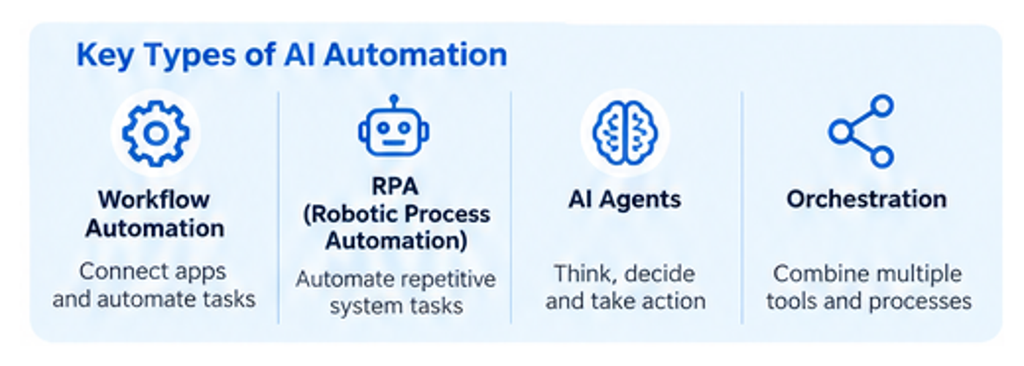
Four common forms of automation: workflows, RPA, AI agents, and orchestration.
AI Automation Tools Worth Knowing in 2026
There is no single platform that is right for every business. Some tools are designed for fast no-code setup, while others provide deeper technical control, self-hosting, enterprise governance, or RPA. The following platforms are useful examples of the different approaches available today.
Zapier
Zapier is focused on connecting apps, automating workflows, and adding AI or agents to business processes. Its current site says it can connect AI and workflows across more than 9,000 apps. That broad integration library makes it attractive for teams that want to automate common cloud tools without building everything from scratch.
A typical Zapier use case could be: new website lead → enrich or classify the lead with AI → add it to the CRM → alert a salesperson → draft a personalized first response.
Make
Make is a visual-first automation platform. Its current product pages describe more than 3,000 pre-built app integrations and tools for workflows, AI agents, AI apps, visual orchestration, analytics, and low-code customization.
Make is especially useful when a team wants to see the logic of a workflow on a visual canvas. That can make multi-step processes easier to understand, debug, and improve.
n8n
n8n is built for teams that want visual workflows plus deeper technical control. Its site says users can connect AI to their data with more than 500 integrations, write JavaScript or Python inside workflows, inspect AI decisions, and deploy on n8n infrastructure or their own infrastructure.
This makes n8n a strong option for technical users who want more control over data, custom APIs, hosting, or complex workflow logic. The trade-off is that advanced setups can require more technical knowledge than a simple no-code workflow.
Microsoft Power Automate
Microsoft Power Automate is designed for automating work across Microsoft and other services. Microsoft documents automated, instant, and scheduled cloud flows, while Copilot can help users describe a workflow in natural language and create a flow from that description.
It can be a practical fit for organizations that already work heavily with Microsoft 365, Teams, SharePoint, OneDrive, Dynamics, or the wider Power Platform ecosystem.
UiPath
UiPath is widely associated with enterprise automation and RPA. UiPath explains AI automation as combining technologies such as machine learning, natural language processing, computer vision, and generative AI with robotic process automation. This approach can be useful for larger processes that involve documents, desktop software, repetitive system tasks, and enterprise controls.
Quick Comparison: Which Type of User Fits Each Tool?
| Tool | Good Fit For | Main Strength | Consideration |
| Zapier | Beginners, small teams, app-heavy workflows | Very broad integration ecosystem and quick setup | Complex workflows can become harder to manage at scale |
| Make | Visual builders and operations teams | Visual canvas, flexible multi-step automation, AI agents | Advanced scenarios still need planning and testing |
| n8n | Technical teams and custom workflows | Code + visual builder, self-hosting options, strong control | Higher learning curve for non-technical users |
| Power Automate | Microsoft-focused organizations | Strong fit with Microsoft ecosystem and enterprise workflows | Licensing and environment setup can be complex |
| UiPath | Enterprise RPA and complex operations | RPA, AI, document and enterprise automation capabilities | Often more than a small business needs for simple tasks |
Real-World AI Automation Use Cases
The value of automation becomes clearer when you connect it to a real task. The goal is not to automate everything. The goal is to remove repetitive work while keeping human judgment where it matters.
Lead Capture and Sales Follow-Up
A business can automatically capture a lead from a website form, check whether the required fields are complete, classify the inquiry, add the lead to a CRM, and notify the correct salesperson. AI can prepare a draft response, but a human can review it before sending when the lead is important.
Customer Support Triage
AI can read incoming support messages, identify the topic, detect urgency, and route the ticket. Common questions can be answered from approved knowledge, while unusual or sensitive issues are sent to a person.
Content and Marketing Workflows
Marketing teams can automate research collection, content briefs, social repurposing, approval reminders, publishing steps, and performance reporting. The safest approach is to let AI help with repetitive preparation while keeping editorial review before publishing.
Document Processing
Invoices, forms, reports, contracts, and other documents often contain information that staff must copy manually. AI-assisted document workflows can extract fields, classify documents, summarize important points, and route files to the right place for review.
Internal Operations
Automation can create onboarding tasks, notify managers, prepare checklists, update databases, summarize meeting notes, and generate recurring reports. Small improvements across many repetitive tasks can save more time than one large “AI transformation” project.
A Simple AI Automation Workflow Example
Imagine a service business that receives new leads through its website. Without automation, someone may need to open the form notification, copy the details into a spreadsheet or CRM, decide who should handle the lead, send a reply, and remember to follow up.
- A visitor submits the website form.
- The automation checks that the contact details are complete.
- AI classifies the inquiry by service type and urgency.
- The lead is added to the correct CRM pipeline.
- The right salesperson receives a notification.
- AI prepares a short first-response draft using approved information.
- A person reviews the draft before it is sent, if approval is required.
- If the lead does not reply, the system creates a follow-up task.
- The result is logged so the team can measure response time and conversion.
This example shows why the workflow design matters more than the AI label. A useful automation has a clear trigger, reliable data, controlled actions, error handling, and a person responsible for the result.
Benefits of AI Automation
- Less repetitive data entry and copying between apps.
- Faster response times for common requests.
- More consistent routing and follow-up steps.
- Better use of existing business data.
- More time for creative, strategic, or customer-facing work.
- Workflows that can run at scheduled times or when an event happens.
- Easier reporting when each step is logged and measurable.
The biggest benefit is usually not “replacing people.” It is giving people a system that handles predictable work so they can focus on decisions, relationships, exceptions, and quality.
Risks and Limitations You Should Not Ignore
AI automation can be useful, but it can also make mistakes faster if the workflow is poorly designed. A good system needs limits, review points, monitoring, and a clear way to recover when something goes wrong.
- AI output can be incorrect, incomplete, or overly confident.
- A workflow can fail when an app changes, a permission expires, or a field is renamed.
- Sensitive data should not be sent to tools without checking privacy and security requirements.
- Automated messages can sound poor or inappropriate if there is no quality control.
- Giving an AI agent too many permissions can increase risk.
- Complex automations need logs, testing, alerts, and a human owner.
| Good practice: Start with low-risk tasks, keep permissions narrow, test with real examples, add human approval for important actions, and review workflow logs regularly. |
How to Choose the Right AI Automation Tool
Do not start by asking, “Which tool has the most AI?” Start by asking what work you want to improve. A clear process makes tool selection much easier.
1. Define the Exact Task
Write down the trigger, the information required, the decisions that need to be made, and the final action. If the process is unclear on paper, automation will not fix the confusion.
2. Check Your Existing Apps
List the tools your team already uses. A platform that connects cleanly to your CRM, forms, email, database, help desk, and cloud storage may be more useful than one with impressive AI features but weak integrations for your stack.
3. Match the Tool to Your Skill Level
A small non-technical team may value a simple visual builder. A technical team may prefer code steps, APIs, self-hosting, version control, and deeper debugging. Choosing a tool that fits the people who will maintain it is important.
4. Think About Control and Privacy
Check how credentials are stored, what data leaves your systems, who can view the workflow, how actions are logged, and whether the platform provides the deployment and governance options your organization needs.
5. Measure Cost by Workflow Value
Do not compare subscription prices alone. Consider run limits, AI model costs, premium connectors, support, developer time, and the value of the hours or errors the workflow can save.
6. Start Small and Scale After Testing
A small reliable automation is better than a huge workflow nobody understands. Build one process, test edge cases, measure the result, and only then add more steps or AI decision-making.
Where Droven.io Fits Into the AI Automation Conversation
Droven.io fits best at the research and learning stage. Its public site organizes content around AI tools, AI automation work, business processes, digital transformation, and related technology topics. That makes it useful as a place to discover ideas and understand trends.
The actual automation work, however, happens inside dedicated platforms such as Zapier, Make, n8n, Power Automate, UiPath, or other workflow and RPA systems. Keeping that distinction clear makes an article more trustworthy and avoids confusing readers.
Frequently Asked Questions
What is Droven.io?
Droven.io is an editorial website that publishes content about artificial intelligence, AI tools, automation, business processes, technology, and digital transformation.
Is Droven.io an AI automation software platform?
Its current public website does not present Droven.io as a standalone workflow automation product. It is better described as an information and editorial platform.
What are AI automation tools?
AI automation tools combine workflows, integrations, AI models, agents, or robotic process automation to reduce manual work and handle tasks such as classification, routing, data movement, drafting, extraction, and decision support.
Which AI automation tool is easiest for beginners?
Ease depends on the workflow, but visual no-code platforms are generally easier to start with than developer-focused systems. It is still important to test the workflow carefully.
Is n8n good for AI automation?
n8n supports visual workflows, AI agents, code steps, custom integrations, and self-hosting options, which can make it useful for technical teams that want more control.
Can AI automation replace employees?
Most useful business automations are designed to remove repetitive steps rather than replace every part of a job. Human review remains important for judgment, quality, exceptions, and sensitive decisions.
What is the difference between automation and AI automation?
Traditional automation follows defined rules. AI automation adds capabilities such as understanding text, extracting information, generating content, classifying inputs, or choosing among possible actions.
Should small businesses use AI automation?
Yes, when there is a clear repetitive task and a measurable benefit. Small businesses should usually begin with low-risk workflows such as lead routing, reminders, data entry, summaries, and internal notifications.
Final Thoughts
The keyword “droven io ai automation tools” can be confusing because Droven.io is not currently presented as a single automation software product. It is an editorial platform that covers AI, automation, tools, technology, and digital transformation.
For actual automation, platforms such as Zapier, Make, n8n, Microsoft Power Automate, and UiPath provide different ways to connect apps, build workflows, use AI, and automate repetitive tasks. The right choice depends on the work you want to improve, your technical skills, the apps you already use, your security needs, and how much control you need.
The best automation strategy is simple: choose one repetitive process, build a small reliable workflow, keep humans involved where judgment matters, measure the result, and scale only after the system is working well.