

AI smut writer is a search term used for AI-assisted tools aimed at mature or adult fiction. In practice, the category overlaps with AI erotica writers, adult-fiction writing assistants, romance-story generators, and general fiction tools that offer different levels of content handling. The important distinction is that a serious writing tool is not judged only by whether it can generate text: writers also need continuity, character consistency, editing control, privacy, project organization, and predictable output.
This guide focuses on the technology, research process, SEO intent, and evaluation criteria behind the category. It does not reproduce graphic sexual material. The goal is to help readers understand what these tools do and how to assess them responsibly.
What Is an AI Smut Writer?
An AI smut writer is a specialized or adapted AI writing system used to assist with mature fiction. Depending on the product, it may help with story ideas, outlines, character profiles, scene drafting, rewriting, continuity, or long-form project management. Some products market themselves specifically around adult fiction, while fiction-first platforms emphasize broader creative writing workflows.
The category is growing alongside a broader shift toward AI-assisted fiction. A 2026 research paper, , analyzed more than 500,000 anonymized English-language ChatGPT conversations and reported that fiction generation—including fanfiction and erotica—forms a substantial part of observed use. The study also identifies recurring patterns such as repeated revisions and demand for highly specific story combinations.
Why Writers Search for These Tools
The strongest user intent is usually practical rather than theoretical. Writers want to know whether a tool can solve problems that appear during long-form drafting:
- Maintain character details across multiple scenes or chapters.
- Remember a story bible, outline, setting rules, and previous events.
- Generate or expand drafts without destroying the author’s intended voice.
- Rewrite passages for tone, pacing, point of view, or clarity.
- Reduce repetitive language and continuity errors.
- Provide a private and understandable workflow for sensitive creative material.
- Offer useful project management instead of behaving like a simple chat window.
Community discussions support these pain points. In a January 2026 Reddit discussion, writers described repetition, unexpected censorship, and small context or memory windows as recurring problems when attempting longer mature-fiction projects. A separate May 2026 thread shows users comparing specialized story tools and discussing whether they are better suited to fiction than general chatbots.
AI Smut Writer vs. a General AI Writing Tool
| Capability | General AI tool | Fiction-focused tool |
| Story outlining | Often available | Usually central to workflow |
| Character memory | Depends on product/context | Often a dedicated feature |
| Chapter organization | Usually external | May be built into the editor |
| Rewrite/edit controls | Common | Often more fiction-specific |
| Genre controls | Broad | Usually more targeted |
| Privacy controls | Provider-specific | Must be checked individually |
| Adult-content handling | Varies by provider | May be a core product feature |
This distinction matters for SEO as well as users. A page that simply defines the keyword may satisfy a basic informational query, but a page that explains the workflow, compares capabilities, tests products, and documents limitations can address informational and commercial-investigation intent together.
Features That Actually Matter
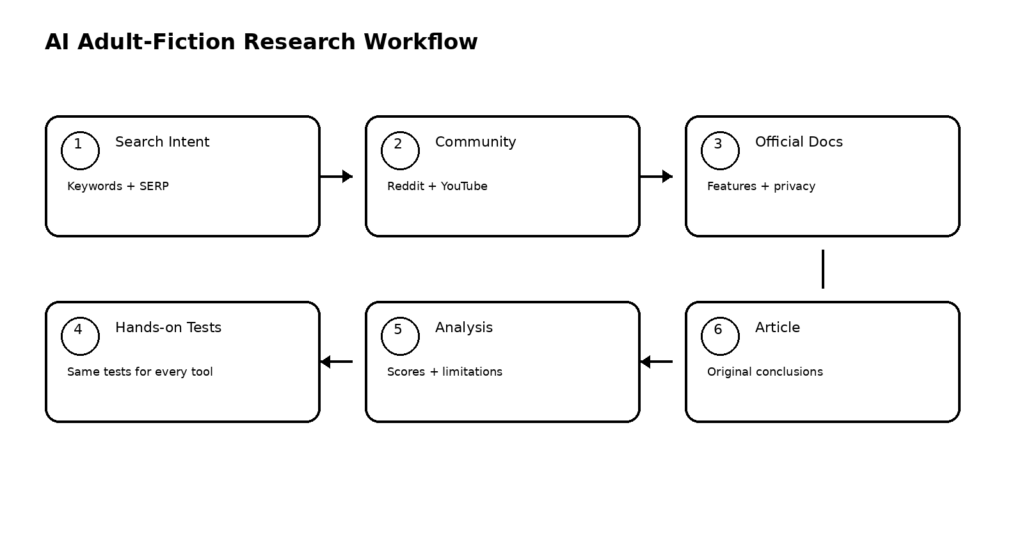
Original research-workflow infographic created for this article.
1. Story memory and continuity: Long-form fiction depends on facts established earlier. A good system should let the writer maintain characters, locations, relationships, plot threads, and chronology. Sudowrite, for example, documents features such as a Story Bible, scene-based drafting, rewriting, brainstorming, and chapter generation. See its official documentation for the exact current feature set.
2. Character consistency: A tool can produce fluent prose while still changing a character’s personality, background, or physical details. Test consistency deliberately rather than assuming that a large context window automatically solves it.
3. Editing and author control: Writers should be able to revise, rewrite, expand, shorten, or change tone without handing the entire manuscript over to the model. A good workflow keeps the author in control.
4. Privacy and data handling: Do not rely on a marketing slogan such as ‘private.’ Check the provider’s privacy policy and terms for storage, retention, training use, account requirements, export, and deletion.
5. Project organization: For long projects, chapter management, notes, character sheets, story bibles, and version control can matter as much as raw prose quality.
6. Predictability: A useful tool should produce reasonably consistent results under repeatable conditions. Test the same task more than once before drawing conclusions.
How to Test an AI Smut Writer
If you want the article to stand out from thin affiliate pages, this is the section to make genuinely original. Use the same evaluation protocol for every product and publish the methodology.
- Create one fictional character sheet with stable traits and background details.
- Create a short story outline with a timeline and several plot dependencies.
- Test a continuation after several preceding scenes and check for contradictions.
- Test rewriting: ask for a clearer, tighter, or more emotionally controlled version of the same non-graphic passage.
- Test long-form organization: chapters, notes, story bible, or equivalent project tools.
- Read the privacy documentation and record what the provider actually states.
- Record pricing, limits, free access, export options, and account requirements on the same date.
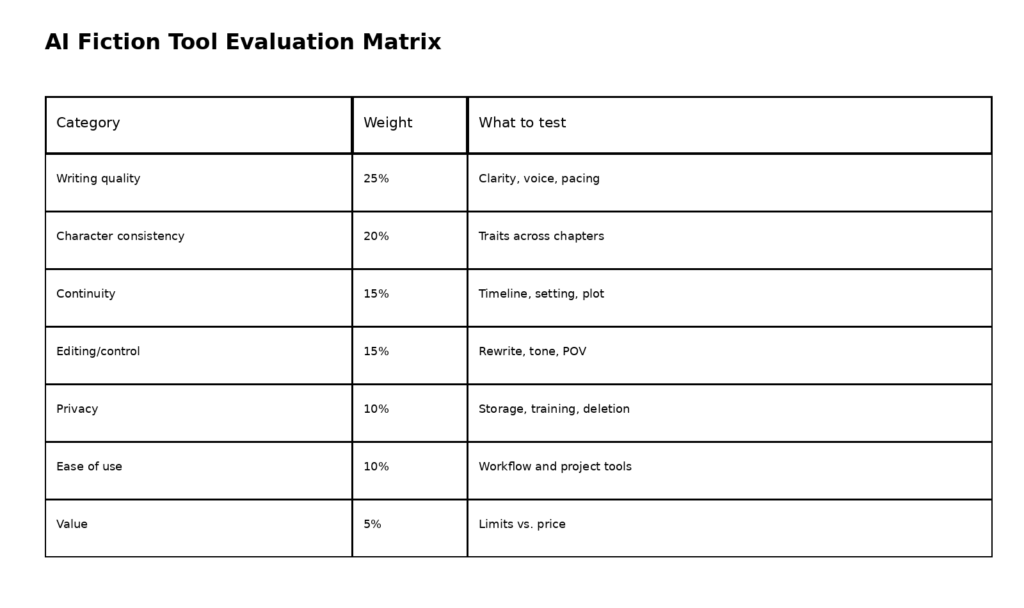
Original scoring matrix for comparing AI fiction-writing tools.
Recommended Scoring Model
| Category | Weight | Measurement |
| Writing quality | 25% | Readability, voice, pacing, coherence |
| Character consistency | 20% | Stable traits across repeated tests |
| Long-form continuity | 15% | Timeline, setting and plot accuracy |
| Editing/control | 15% | Rewrite, tone, POV and instruction following |
| Privacy | 10% | Documented storage/training/deletion practices |
| Ease of use | 10% | Workflow, organization and usability |
| Value | 5% | Limits relative to price |
What Current Research Says About AI Fiction Quality
AI fiction is not simply a question of ‘good’ or ‘bad’ writing. A 2026 study calledexamined tens of thousands of stories and found measurable differences between AI-generated and human-authored fiction in narrative structure, including tendencies toward over-explaining themes, tidy single-track plots, and different patterns of character agency and chronology.
Another 2026 paper,, found that AI assistance can change how readers perceive the writer’s persona. For authors, this is a reminder that editing is not only about grammar: preserving voice and intentionality matters.
A separate 2026 study reported by The Guardian found that participants sometimes rated AI-generated short stories highly and often struggled to distinguish AI-written from human-written stories. Read the report The finding does not mean AI automatically produces better fiction; it shows that perceived quality, authorship expectations, and actual text quality can diverge.
What Reddit and YouTube Are Useful For
Reddit is most valuable for discovering real user pain points, not for proving product claims. Search communities for recurring complaints, workflow preferences, and comparisons. Look for patterns across multiple threads instead of quoting one anonymous comment as fact.
YouTube is useful for demos and first-hand workflow observation. Search for current reviews and screen-recorded tests, but verify important claims against official documentation. A video can show how a feature behaves; it should not automatically be treated as proof of pricing, privacy, retention, or policy.
Official Product Claims: Verify Before You Publish
Product pages are marketing sources, so label claims accurately. For example, Sudowrite’s official documentation describes fiction-focused tools such as Write, Describe, Rewrite, Brainstorm, First Draft, Expand, Scenes and Draft. SmutWriter’s own pages describe features including story bibles, chapter management and privacy claims. Those are the companies’ claims; an independent review should test what can actually be verified.
Privacy: The Question Many Reviews Skip
- Where are drafts stored?
- Are drafts used to train models?
- How long are logs or account records retained?
- Can the user export and delete projects?
- Is an account required?
- What happens when a subscription ends?
- Does the provider distinguish between prompts, generated text, analytics and support data?
Do not convert a provider’s ‘private’ or ‘secure’ marketing language into an absolute guarantee. Quote or paraphrase the actual policy and include a date so readers know when it was checked.
SEO Strategy: How to Make the Page Useful to Google and Readers
There is no single SEO metric that guarantees a page will rank. Google’s current Search Central guidance emphasizes helpful, reliable, people-first content and asks creators whether their pages provide original research, substantial coverage, and first-hand expertise. Google: Creating Helpful, Reliable, People-First Content
For this topic, the strongest SEO signals you can influence are usefulness and originality:
- Cover the core definition quickly, then add information competitors do not have.
- Show your testing methodology and disclose what you actually tested.
- Use original screenshots or original diagrams where possible.
- Cite official documentation for factual product claims.
- Use Reddit and YouTube as community/experience evidence, not as unquestioned authority.
- Keep author information, publication date and update date visible.
- Build internal links to related pages on your own site.
- Use descriptive, crawlable links and meaningful anchor text.
Google’s link guidance explains that links help crawlers discover pages and understand relevance, and recommends descriptive anchor text. Google: Link Best Practices
If this article is published on a website, Article structured data can also help Google understand the headline, author, images, and dates. Google: Article structured data
Suggested Internal-Link Cluster
- AI writing tools comparison
- Best AI tools for fiction writers
- AI character consistency guide
- How to write a novel with AI
- AI writing privacy checklist
- AI-generated content and publishing
- AI writing prompts for fiction
These should become real internal URLs on the site once those supporting pages exist. Do not invent internal URLs just to create links.
Common SEO Mistakes to Avoid
Keyword stuffing: Repeating ‘AI smut writer’ unnaturally does not make the article more authoritative.
Mass-produced pages: Creating dozens of near-identical AI pages around tiny keyword variations can become low-value scaled content.
Unverified product claims: Do not copy ‘best’, ‘private’, ‘fastest’, or user-count claims without labeling them as claims or independently testing them.
Fake hands-on testing: Never say you tested a product if you did not.
Thin affiliate content: A list of tools plus affiliate links is not enough; add original evaluation and decision support.
Ignoring updates: Pricing, policies, models and features change. Recheck important facts before each major update.
Google explicitly warns against content created primarily to manipulate rankings, including extensive automation used for search-engine manipulation. Google Search Essentials
Who Should Use an AI Adult-Fiction Writing Tool?
- Writers who want brainstorming or outlining help.
- Authors working on long-form projects who benefit from structured project memory.
- Writers who want rapid drafts but still intend to edit and shape the final work.
- Authors comparing specialized fiction workflows with general AI tools.
Who should be cautious? Anyone who expects the tool to replace editorial judgment, guarantee originality, guarantee privacy, or produce publication-ready work without review. AI can accelerate drafting while still introducing continuity problems, repetitive language, factual errors, or a generic voice.
FAQ
What is an AI smut writer?
It is an AI-assisted writing tool aimed at mature or adult fiction. Depending on the product, it may support outlining, character development, drafting, rewriting, continuity, and project organization.
What is the difference between an AI smut writer and a general AI chatbot?
The main difference is workflow specialization. Fiction-focused tools may provide story bibles, chapter organization, character memory, scene controls and fiction-oriented editing features, while general chatbots are broader-purpose systems.
Is a free AI smut writer always the best choice?
No. Free access can be useful for testing, but compare output quality, continuity, privacy, limits, exports and long-form workflow before choosing.
How should I test an AI fiction writing tool?
Use the same fictional character, outline and editing tasks across tools, then score writing quality, character consistency, continuity, control, privacy, usability and value.
Can AI maintain character consistency?
Sometimes, but it depends on the model, context handling and product design. Treat continuity as something to test rather than assume.
Should AI-assisted fiction be edited by a human?
Yes, especially for voice, continuity, originality, pacing, and factual or contextual errors. AI output should be treated as draft material unless the writer has independently reviewed it.
Does Google automatically penalize AI-written content?
Google’s guidance focuses on whether content is helpful, reliable and created for people rather than search manipulation. The issue is low-value, unoriginal or search-engine-first content—not simply the presence of AI assistance.