
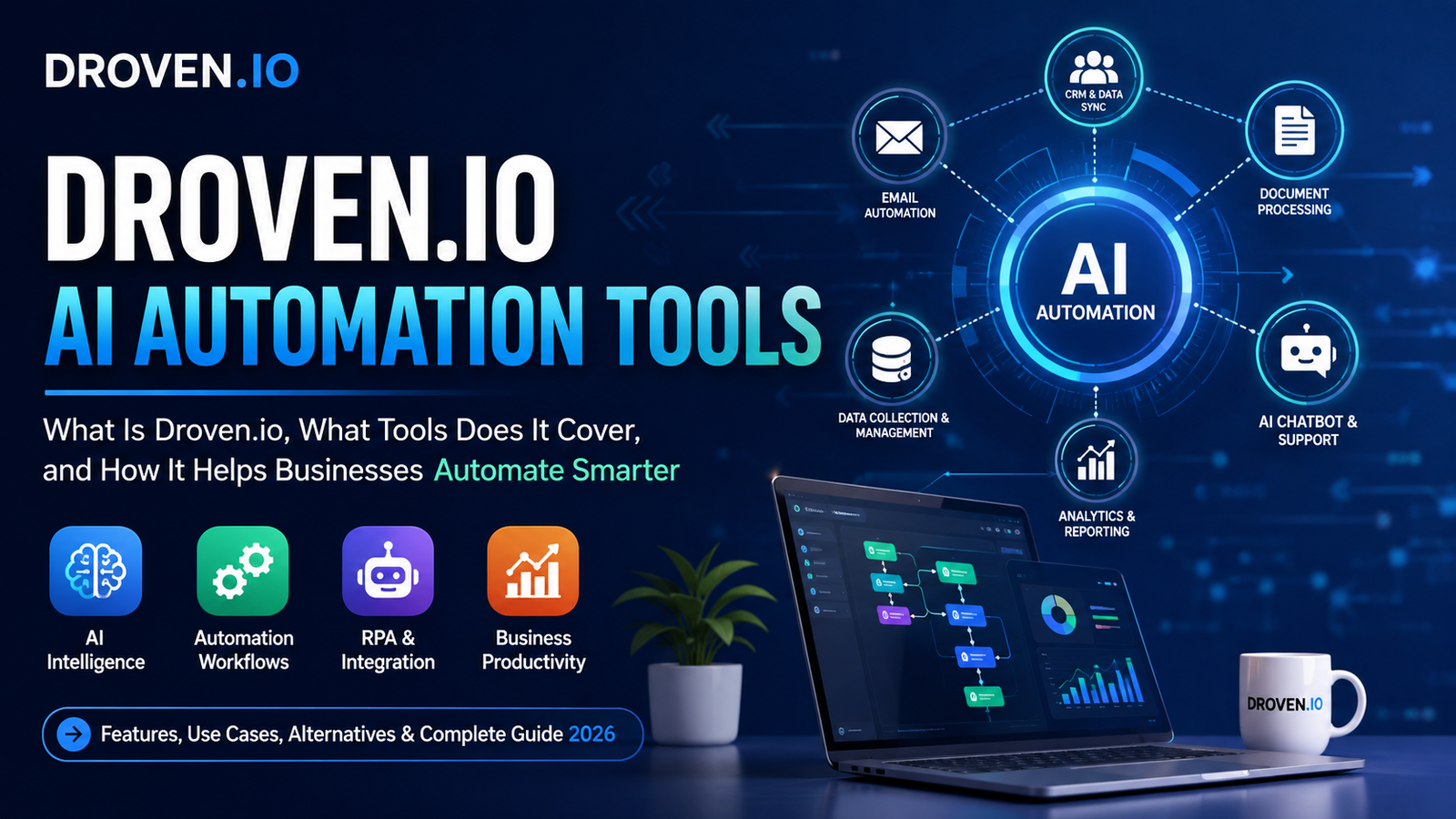
If you searched for “droven io ai automation tools”, you may expect to find a software platform where you can build and run automations. Current public evidence points to a more nuanced answer: Droven.io is presented primarily as an editorial or knowledge platform covering artificial intelligence, automation, RPA, machine learning, cloud, cybersecurity and related technology topics, rather than as a conventional automation SaaS product.
If you are new to AI automation, you should also read our guide on what is AI automation and how it works.
Droven.io This distinction matters because some third-party pages use the exact phrase as though it were a product name, while Droven.io’s own descriptions emphasize technology education.
Table of Contents
What Is Droven.io?
Based on its own current public positioning, Droven.io is a technology information and editorial platform. Its categories include AI tools and applications, machine learning, generative AI, AI automation for work, automation and RPA, AI in business processes, cloud computing, cybersecurity, software development and emerging technology. AI category technology categories. The practical role is to help readers understand technologies and make better decisions before selecting software.
Is Droven.io Actually an AI Automation Tool?
Not in the conventional SaaS sense, based on the platform’s own public descriptions. A workflow automation platform normally provides triggers, actions, integrations, execution, logs and monitoring. Droven.io is positioned as a place to understand AI, automation and related technologies rather than as a product that runs a user’s workflows.
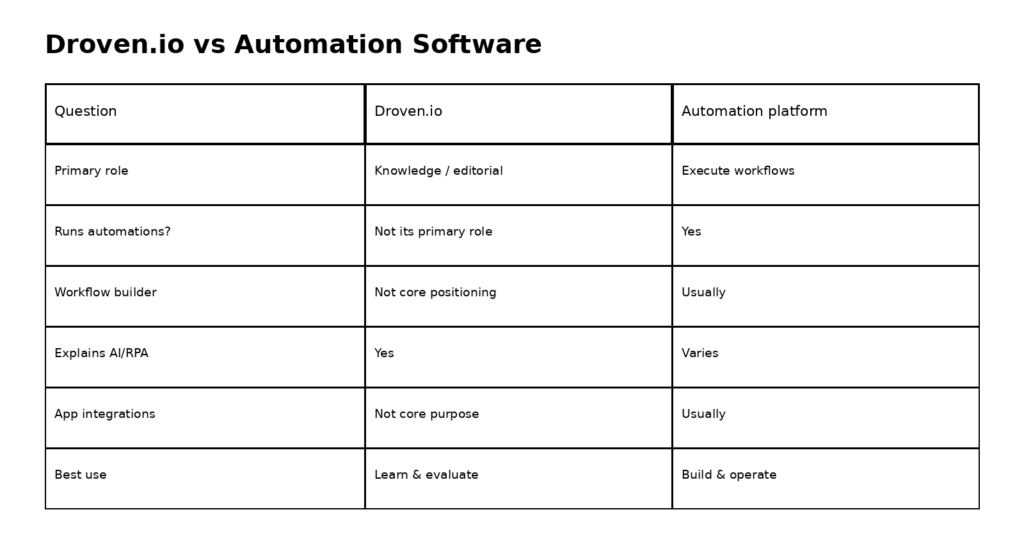
| Capability | Droven.io positioning | Typical automation SaaS |
| Primary purpose | Explain and contextualize technology | Build and execute workflows |
| Execute automations | Not the primary positioning | Core function |
| Workflow builder | Not presented as core SaaS functionality | Common |
| AI/RPA education | Core content area | Varies |
| App integrations | Not the core proposition | Common |
| Best fit | Research and learning | Operations and execution |
Why People Search for “Droven.io AI Automation Tools”
- AI automation is a fast-growing business category, creating demand for plain-language explanations.
- Searchers may be looking for automation topics covered by Droven.io rather than a product to install.
- Third-party articles use the exact phrase in titles, which can reinforce the assumption that Droven.io itself is automation software.
- Brand + category searches often combine navigational and commercial-investigation intent.
How AI Automation Actually Works
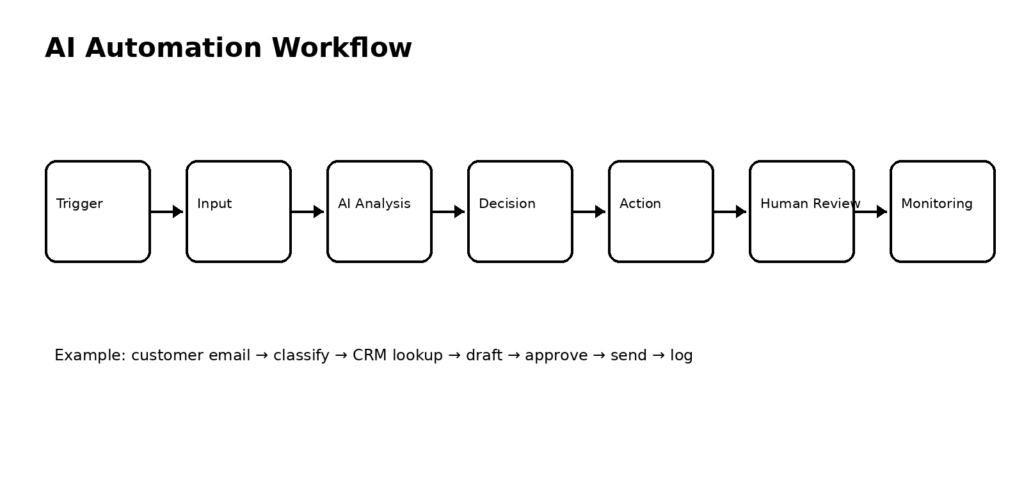
A typical AI-assisted workflow starts with an event such as an email, form submission or document. The system extracts information, applies AI classification or reasoning, decides what should happen next, performs an action in another system, and records the result. For sensitive or high-impact decisions, human approval can remain in the loop.
AI Automation vs Traditional RPA
Traditional RPA is strongest when a process is stable, structured and rule-based. Research on intelligent RPA describes machine learning as a way to broaden automation beyond purely symbolic bots. 2025 intelligent-RPA taxonomy A comparative study found conventional RPA stronger in speed and reliability for repetitive stable enterprise tasks, while LLM-agent approaches reduced development effort and adapted more flexibly to changing interfaces. RPA vs LLM-agent study
| Factor | Traditional RPA | AI / agentic automation |
| Logic | Rules and predefined steps | Can interpret context |
| Data | Best with structured inputs | Can handle more unstructured inputs |
| Predictability | Usually high in stable workflows | Can be less predictable |
| Flexibility | Lower when processes change | Potentially higher |
| Oversight | Useful for exceptions | Often important for decisions and edge cases |
AI Automation Tools That Actually Execute Workflows
If your goal is to build and run automations, compare actual automation platforms rather than treating Droven.io as an execution layer.
Zapier: App-to-app workflow automation and integrations. Official site
Make: Visual workflow automation and branching. Official site
n8n: Flexible workflow automation for technical and self-hosting scenarios. Official site
UiPath: Enterprise automation and RPA. Official site
Microsoft Power Automate: Workflow and business-process automation in the Microsoft ecosystem. Official site
Real-World AI Automation Use Cases
Customer support: Classify incoming requests, extract order information, retrieve customer records, draft responses and route exceptions to people.
Lead qualification: Read submissions, extract business details, classify intent and route qualified leads to a CRM.
Document processing: Extract invoice or form fields, apply rules, flag anomalies and send uncertain cases for review.
Content operations: Turn structured inputs into drafts or summaries, then route them through approval and publishing.
Operations reporting: Collect data, summarize trends, generate reports and notify the relevant team.
Research Evidence on AI Automation
Research suggests AI can expand automation into unstructured data and exception-heavy tasks, while reliability and governance remain important. A 2025 expense-processing case study combined OCR/intelligent document processing, policy classification, generative AI for exceptions and human review, reporting major reductions in processing time. Read the case study Another study explored NLP and language-model methods for helping RPA retrieve information from unstructured documents. Unstructured-data RPA study
Reddit Research: What Practitioners Are Discussing
Reddit is valuable for discovering real-world concerns, but it is community evidence rather than authoritative product documentation. Recent RPA discussions show practitioners debating whether AI agents replace or complement RPA. June 2026 RPA benchmark discussion Another discussion described continued use of RPA for structured workflows while considering AI for unstructured inputs and edge cases. February 2026 RPA discussion The useful takeaway is not that one technology has won, but that hybrid stacks can combine rules, APIs, AI, human approvals and monitoring.
YouTube Research: How to Use It Correctly
- Droven.io review/walkthrough
- AI automation workflow demos
- RPA vs AI agents
- Zapier vs Make vs n8n
- AI agents for business automation
- Enterprise automation case studies
Use videos to observe demos and user experience, but verify pricing, privacy, policies and product capabilities against official documentation. A creator’s opinion should be labeled as an opinion.
How to Research This Topic Properly
1. Start with Droven.io’s own pages and record how it describes itself.
2. Map the exact keyword cluster and search intent.
3. Review the top-ranking pages for claims and content gaps.
4. Search Reddit for brand mentions and broader AI/RPA practitioner discussions.
5. Search YouTube for current demonstrations and reviews.
6. Verify product claims with first-party documentation.
7. Use academic research to explain AI automation and RPA.
8. Separate first-party statements from third-party claims.
9. Never claim a hands-on test that was not performed.
SEO Metrics That Actually Matter
There is no fixed “Google pass score.” Google’s Search Essentials emphasize technical eligibility, spam policies and helpful, reliable, people-first content, and note that meeting requirements does not guarantee crawling, indexing or ranking. Google Search Essentials After publication, monitor Search Console impressions, clicks, CTR, average position, queries and indexing; use analytics for organic engagement and conversions.
Keyword placement: Use the primary phrase naturally in the title, H1, introduction and relevant subheading.
Semantic coverage: Cover AI automation, RPA, workflow automation, AI agents, business processes, integrations and governance.
Original research: Add your own methodology, comparisons, screenshots or tests.
Internal links: Link to relevant pages on your own site with descriptive anchor text.
External references: Use first-party, academic and reputable industry sources for factual claims.
Authorship: Show a real author, publication date and meaningful update date.
Google Rules to Avoid Problems
Google recommends helpful, reliable, people-first content and using words people search for in prominent locations such as titles, headings, alt text and link text. Google Search Essentials Its spam policies also cover scaled content abuse—large amounts of low-value pages created primarily to manipulate rankings. Google spam policies Do not create dozens of nearly identical Droven.io keyword pages just to capture variations.
Current Content Gap
- Clearly distinguish Droven.io from actual automation SaaS.
- Explain AI automation versus RPA with evidence.
- Show a real workflow diagram rather than generic stock imagery.
- Use practitioner discussions as community evidence.
- Publish methodology and verification notes.
- Compare actual automation platforms only after checking their official documentation.
- State limitations and uncertainty instead of making absolute claims.
FAQ
What is Droven.io?
Based on its current public descriptions, Droven.io is a technology-focused information/editorial platform covering AI, automation, RPA, machine learning, cloud, cybersecurity and related subjects.
Is Droven.io an AI automation tool?
It is not positioned by its own public descriptions as a conventional SaaS automation platform. It is better described as a knowledge platform covering AI automation and related technologies.
What does “Droven.io AI automation tools” mean?
The phrase can refer to Droven.io in the context of AI automation topics it covers. It should not automatically be interpreted as the name of one automation application.
What is AI workflow automation?
It combines workflow triggers and integrations with AI capabilities such as classification, extraction, summarization or decision support.
Is AI automation the same as RPA?
No. RPA traditionally automates structured, repeatable, rule-based tasks. AI can add interpretation and flexibility, but can also introduce additional reliability and governance concerns.
Which tools actually run business automations?
Examples include Zapier, Make, n8n, UiPath and Microsoft Power Automate. The right option depends on integrations, technical requirements, governance and use case.
Can AI automation replace human workers?
It can reduce repetitive work, but human oversight remains important for exceptions, quality control, sensitive decisions and costly-to-reverse actions.
How should I evaluate an AI automation tool?
[…] Best Software for Beginners in 2026 is software that helps you complete a real task before it asks you to understand dozens of technical settings. […]
[…] workflows because it does more in one automation. Zapier is good for simple connections, but Drowen.io is better if you want AI to make […]
[…] if you want to learn more about AI for small businesses, read our guide on Best AI Tools for Small Businesses in 2026 and Best AI Scheduling Tools in […]
[…] That day, I realized something important. Automation is not about being lazy. It is about not forgetting things. As humans, we forget to follow up. We get busy. We miss leads. Droven.io does not forget. […]